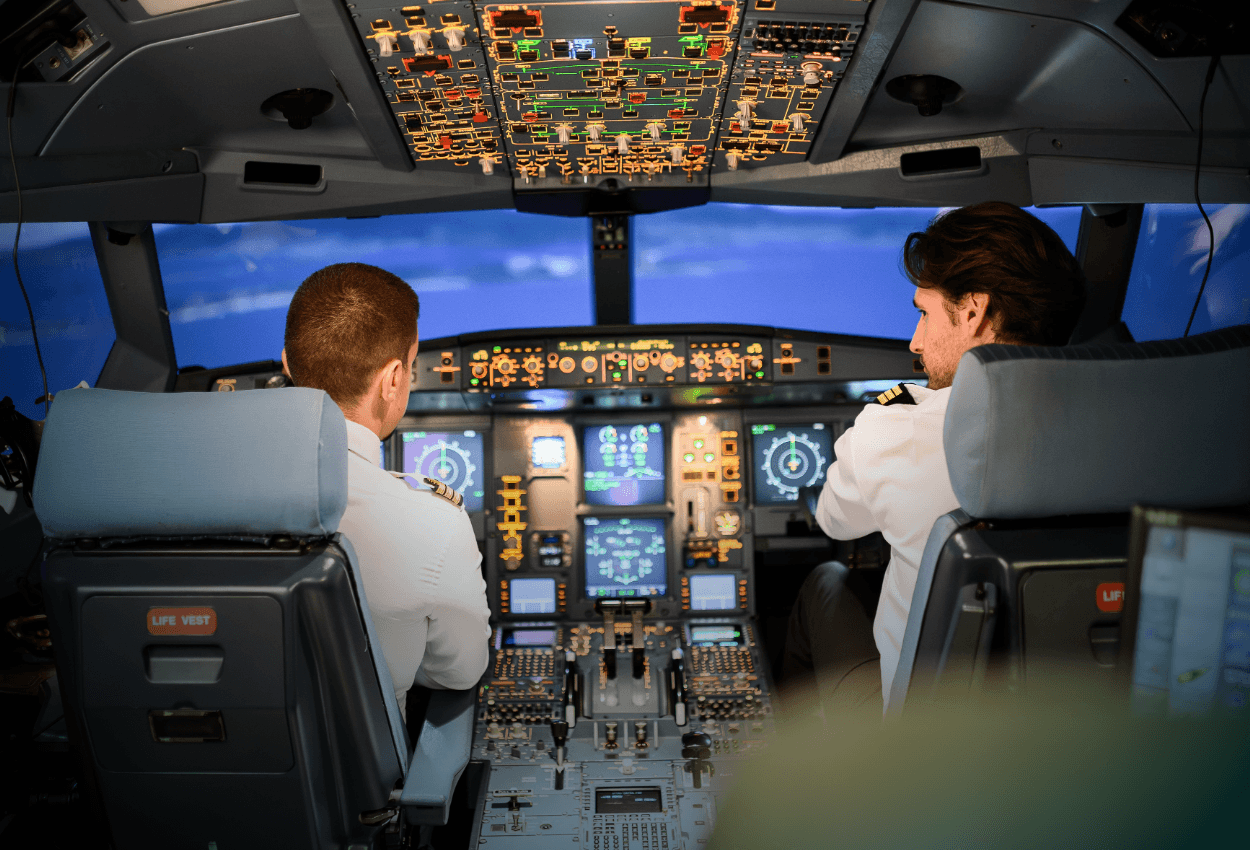
If you work anywhere near aviation training today, you’ve almost certainly heard the acronym CBTA — Competency Based Training and Assessment. It’s everywhere: airline training departments, instructor briefings, regulator updates, and industry conferences. But despite being widely discussed, CBTA often feels like an abstract concept —something theoretical, complex, and, for many pilots and training managers,frustratingly unclear.
That’s exactly why Simaero launched The Training Standard podcast and a CBTA focused first series, starting with Episode1: “From Buzzword to Blueprint: understanding the CBTA philosophy.” In this first conversation, host and Training Manager for South Africa Bryan Rosevearesits down with Simaero’s Training Manager for France and CBTA Subject MatterExpert, Cédric Coffignal, to break down what CBTA actually means — and why it represents one of the most significant training evolutions in aviation in decades.
Let’s explore what this philosophy is, how it differs from traditional training, and why it matters for the future ofsafety and performance.
A common question in the industry is: whatis competency based training, and why it could replace legacy training models?
In simple terms, competency based trainingand assessment in aviation shifts the focus away from repeating tasks untilthey are memorized, and instead focuses on developing the behaviors and competencies that allow pilots to manage real-world complexity.
Cédric explains CBTA in a way that immediately cuts through the confusion: Legacy training attempts to train pilots on an infinite number of tasks, so they can handle a finite number of situations. CBTA does the opposite: it trains pilots on a finite number of competencies, so they can handle an infinite number of situations.
This is the heart of the competency based training model — building adaptable pilots, not just compliant ones.
To truly understand CBTA, you must compare it to the older system.
Traditional recurrent training has typically relied on task repetition: steep turns, engine failures, rejected takeoffs, approach profiles — repeated again and again. Performance is often measured by whether the crew “passed” the maneuver.
The weakness of this approach is that it can lead to “training for the test,” rather than training for operational resilience.
CBTA still uses tasks — but tasks become tools, not goals. A maneuver is no longer assessed as “good” or “bad” on its own. Instead, instructors evaluate what that task reveals about the pilot’s underlying competencies.
This is where competency based training vs traditional training becomes a fundamental philosophical split.
One of the biggest benefits of CBTA is that it provides a structured, objective framework for evaluating performance beyond stick-and-rudder skill.
According to Cédric, CBTA offers legitimacy for instructors to assess competencies that have always mattered, but were often difficult to grade objectively — such as leadership, teamwork, ordecision-making.
Some key characteristics of competencybased training and assessment include:
In CBTA, “airmanship” is no longer a vague concept. It becomes measurable through behavior-based indicators.
The importance of implementing CBTA isclosely tied to modern aviation realities.
Aircraft systems have become increasingly automated and technically complex. Airline environments have also become more demanding — high traffic density, operational pressures, mixed-experience crews, and rapidly changing threats.
Despite aviation being one of the safest industries in the world, accidents and serious incidents still happen. CBTA is designed to close the gap between training environments and real operational challenges.
As Cédric notes, CBTA also supports a global safety language. If all airlines and training organizations evaluate performance through the same competency framework, data becomes comparable and meaningful worldwide.
A practical way to understand CBTA isthrough real simulator scenarios.
Bryan uses a classic example: the V1 engine failure. In a traditional training model, the exercise is repeated until it meets the required standard. If the pilot misses a callout or delays a procedure, they repeat the maneuver until it is correct.
But CBTA takes a deeper approach.
If a crew performs poorly during a V1 cut due to communication issues, repeating the exact same task may not prove improvement — because the crew is simply applying a correction in the same context.
CBTA asks a bigger question:
If this crew is placed in a different scenario, will they demonstrate the same competency?
That’s why these examples are powerful: they show how CBTA aims to validate transferable behaviors.
CBTA is not about whether the pilot memorized the steps. It is about whether the pilot can manage threats, detect errors, and correct them under pressure.
The advantages of competency based trainingand assessment are substantial for airlines, instructors, and regulators.
Instead of saying “your steep turn waspoor,” CBTA identifies why it was poor — monitoring, workloadmanagement, or situational awareness.
CBTA formally integrates competencies suchas communication, teamwork, and leadership, rather than treating them asinformal CRM discussion points.
CBTA supports tailored training pathways. If communication is weak, instructors can select exercises specifically designed to trigger communication behaviors — rather than repeating a maneuver that may not address the core issue.
CBTA is built around the idea that human error is normal — what matters is detecting it and correcting it effectively.
We will dive deeper into the advantages ofthe CBTA philosophy in the next episodes.
Is CBTA mandatory yet? Not officially.
However, Cédric highlights that major industry players like IATA and Airbus are strongly pushing CBTA and EBT adoption, and regulators are actively preparing new frameworks.
The message is clear: CBTA is not a passing trend. It is rapidly becoming the global benchmark for training excellence.
CBTA is often misunderstood because people assume it is just a modern label for what good instructors already do. But CBTAis more than intuition — it is a structured philosophy designed to improve safety, create consistency, and train pilots for the complexity of real-world operations.
In Episode 1 of The Training Standard, Simaero sets the foundation: CBTA is not about ticking boxes. It is about building resilient pilots who can handle the unexpected.
Watch the full discussion on YouTube, or your favavourite streaming channel.
Simaero is a world-leading provider of pilot training on full-flight simulators and simulation engineering solutions. In global aviation, change is a constant. We promise to be a straightforward and continual presence in the complex training requirements of international airlines and pilots. With five training centres strategically located in France (headquarters), South Africa, China and India, Simaero trains over 5,000 pilots every year from 250+ civil and military carriers and 80+ countries. Our simulator fleet and training solutions cover the main commercial aircraft types, including Airbus, Boeing, ATR, and Embraer.


©Simaero Holding. 26 avenue de la demi-lune, 95700 Roissy-en-France, France