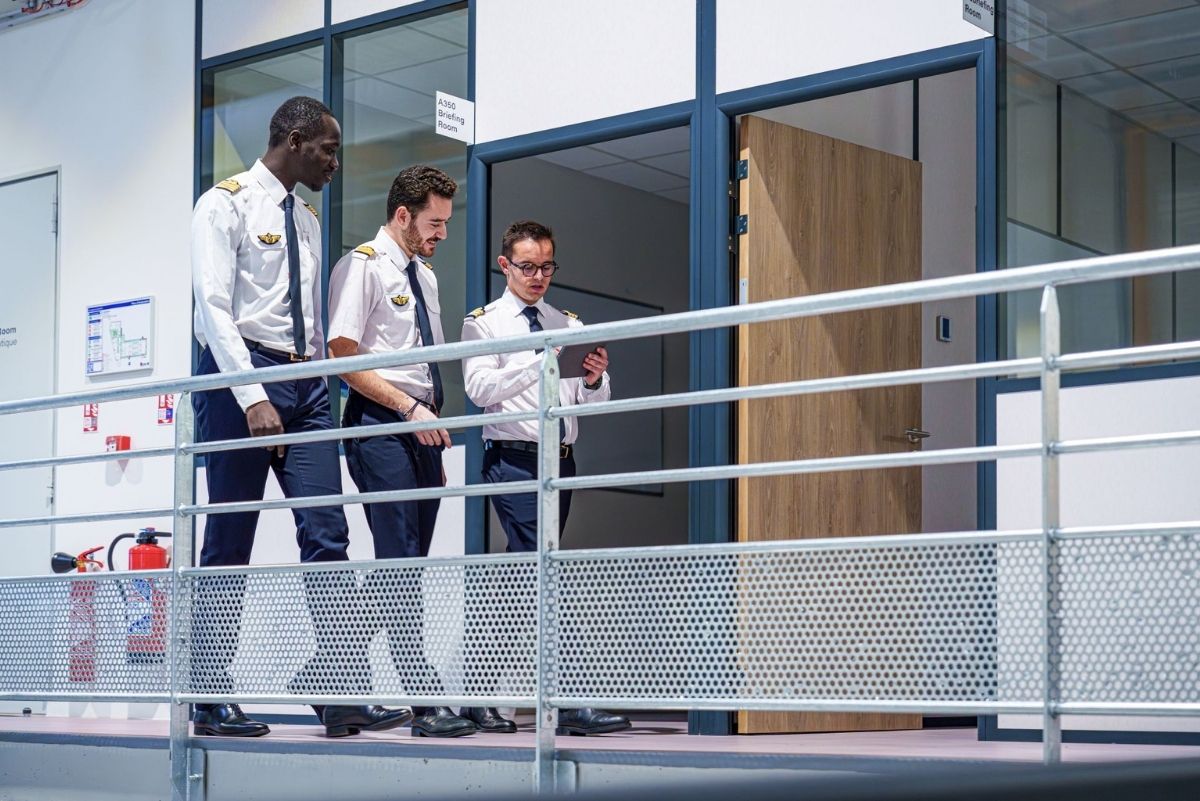
You may know your aircraft inside out. You can manage the automation, anticipate the threats, and work through an abnormal situation without losing sight of the bigger picture. But there is a different question worth asking: could you teach another pilot to do the same?
That is the transition at the heart of becoming a TRI, or Type Rating Instructor.
For experienced pilots, type rating instructor training is more than another qualification to add to a license. It is a move from operating an aircraft to helping other pilots understand how to operate it safely and competently.
Under the EASA framework, becoming a TRI requires the right operational experience, formal instructor training, and an Assessment of Competence. EASA’s current Aircrew framework is established under Regulation (EU) No 1178/2011, with the consolidated Easy Access Rules bringing together the applicable requirements and guidance.
So, what does the path actually look like and what makes a good line pilot a good instructor?
A Type Rating Instructor is a qualified instructor who trains pilots on a specific aircraft type for which the instructor holds the required privileges.
However, the role goes well beyond demonstrating procedures: a TRI needs to brief, observe, identify why performance is going wrong, intervene appropriately, and turn each simulator session into a meaningful learning experience.
At Simaero, TRI training is designed for pilots who already hold a type rating on the aircraft for which they want to become instructors. Candidates learn to conduct the complete training sequence, from briefing and instruction to observation and debriefing, before demonstrating their instructional ability during an Assessment of Competence.
It is important to note that pilots sometimes refer informally to a “TRI license,” but EASA treats the TRI as an instructor certificate. While a TRI evaluates pilot performance throughout training, formal licensing skill tests and proficiency checks require the appropriate examiner privileges.
This distinction becomes important if/when you decide to progress from instructor to examiner.
For a TRI on a multi-pilot airplane, or TRI(MPA), the entry requirements are aimed at pilots who already have substantial operational experience. Simaero’s EASA TRI course requirements specify a CPL, MPL, or ATPL in the applicable aircraft category, at least 1,500 hours as a pilot on multi-pilot airplanes, and recent experience on the relevant aircraft type.
More specifically, the principal type rating instructor requirements for an initial TRI(MPA) include:
The requirements differ for single-pilot aircraft, helicopters, and other TRI categories, so eligibility should always be checked against the exact certificate and privileges you are seeking. EASA’s Aircrew rules are periodically amended, and EASA advises users of its Easy Access Rules to check for regulatory changes adopted after the publication date of the consolidated edition.
But meeting the hour requirement is only the starting line. Having experience gives you material to teach from; it does not automatically supply you with knowledge on how to teach.
EASA type rating instructor training develops instructional competence as deliberately as a type rating develops aircraft competence. For a multi-pilot aircraft TRI, the regulatory training framework includes teaching and learning, aircraft-specific technical training, practical instruction, and an Assessment of Competence.
EASA specifies at least 25 hours of teaching and learning, followed by at least 10 hours of technical training related to the aircraft type. The technical element includes refreshing aircraft knowledge, preparing lesson plans, and developing classroom and simulator instructional skills. For a multi-pilot aircraft, the course also includes at least 10 hours of flight instruction on the applicable aircraft type or an FFS representing it.
At Simaero, that progression is organized into three practical phases. The first develops teaching methods and the ability to recognize trainee weaknesses, assess performance, and account for human factors. The second concentrates on technical instruction and briefing/debriefing skills, with the TRI candidate stepping into the instructor role. The third moves into type-specific full-flight simulator training, where you learn to manage an entire session from the initial brief to the final debrief.
And this is where the mindset starts to change.
As a pilot, when you see an error developing, your instinct may be to solve it. As an instructor, you have to decide whether to intervene, let the trainee recognize it, allow the scenario to develop further, or revisit it later. The learning value often lies not in how quickly you can identify the answer, but in how effectively you help the trainee reach it.
The final Assessment of Competence, or AoC, tests that ability. EASA requires instructor applicants to demonstrate the instructional competencies defined in Part-FCL to an appropriately qualified examiner. At Simaero, the TRI/SFI AoC is built around a type-rating syllabus session and covers the briefing, FFS session, and debriefing under the responsibility of a TRE.
A strong TRI needs more than aircraft knowledge: the real skill is turning operational experience into learning that another pilot can use.
EASA’s instructor competencies include preparing resources, creating an environment conducive to learning, presenting knowledge, integrating Threat and Error Management and CRM, facilitating learning, assessing performance, monitoring progress, and evaluating training sessions.
Think about what that means in a simulator.
EASA’s Flight Examiner Manual gives a revealing picture of what assessors look for. A TRI candidate should be able to recognize trainee errors, establish their root causes, prioritize the most important issues, maintain a positive training environment, and provide timely instruction without unnecessarily increasing the trainee’s workload or creating confusion.
That is why communication, patience, adaptability, judgment, and objective assessment matter so much. The best instructor is not necessarily the person who talks the most. Often, it is the person who knows when to explain, when to ask a question, when to intervene, and when to let the crew work the problem;an inference closely aligned with EASA’s guidance on balancing instruction, trainee practice, error recognition, and feedback.
A TRI primarily develops pilot performance; a Type Rating Examiner, or TRE, formally tests or checks it. The two roles are related, but they carry different privileges and require separate qualification pathways.
A TRI teaches and guides pilots through type-related training. A TRE may conduct activities such as skill tests for the initial issue of a type rating, proficiency checks for revalidation or renewal, and Assessments of Competence for TRI or SFI certificates, subject to the applicable privileges and regulatory requirements.
For many experienced pilots, becoming a TRI is therefore a natural step toward a broader training and checking career. It does not automatically make you an examiner: EASA examiner privileges are governed separately, with their own standardization and competency requirements.
A useful way to remember the type rating instructor vs type rating examiner distinction is simple: the instructor helps build the standard; the examiner verifies whether the required standard has been achieved.
Simaero provides TRI training through its EASA Approved Training Organization, registered as FR.ATO.0011, with type-specific practical training conducted on full-flight simulators. Its training network includes more than 150 type rating instructors and examiners, many of whom are active or retired commercial airline pilots.
Simaero currently offers TRI/SFI courses in Paris, covering teaching and learning, technical instructor development, full-flight simulator practice, and the final Assessment of Competence. The number of practical simulator sessions can be adapted according to the candidate’s previous experience.
For international pilots, Simaero can also assist with training-partner pairing when a complete crew is required and can provide supporting visa documentation once the required training deposit has been received.
You already know what it means to be responsible for an aircraft and its crew. Becoming a TRI asks you to take on a different kind of responsibility: helping the next pilot build the judgment, competence, and confidence to do the same.
That is what makes type rating instructor training more than a career progression. It is the point where your own flying experience starts becoming someone else’s training advantage.
Start your journey toward becoming a certified Type Rating Instructor with Simaero and speak with our training team about your eligibility, aircraft type, and upcoming TRI course schedules.
Simaero is a world-leading provider of pilot training on full-flight simulators and simulation engineering solutions. In global aviation, change is a constant. We promise to be a straightforward and continual presence in the complex training requirements of international airlines and pilots. With five training centres strategically located in France (headquarters), South Africa, China and India, Simaero trains over 5,000 pilots every year from 250+ civil and military carriers and 80+ countries. Our simulator fleet and training solutions cover the main commercial aircraft types, including Airbus, Boeing, ATR, and Embraer.


©Simaero Holding. 26 avenue de la demi-lune, 95700 Roissy-en-France, France